
The Psychology of Dressing Well: How Your Clothes Shape Your Mood, Confidence, and Mindset
Most people treat getting dressed as the last small task before leaving the house. Pick a shirt, pick pants, walk out the door. But research in psychology tells a different story. What you wear does not just reflect how you feel. It actually changes how you feel.
Put on a sharp blazer, and you might stand a little taller and speak with more confidence in a meeting. Wear the same worn-out hoodie every day for a week, and you might notice your motivation slowly fades. This is not in your head. It is a documented effect called enclothed cognition, and once you understand it, you will never think about your closet the same way again.
This guide covers the full picture: the science behind why clothes affect your mind, how color changes your mood, how to dress for the outcome you want, and a simple plan for building a wardrobe that supports you instead of working against you.
Quick answer: Yes, clothing affects your mood and confidence. Studies show that what you wear changes your focus, your self-perception, and even how well you perform on certain tasks. The effect is strongest when a piece of clothing has personal meaning to you and you are physically wearing it, not just looking at it.
What Is Enclothed Cognition?
In 2012, two researchers named Hajo Adam and Adam D. Galinsky ran a study at Northwestern University that gave us the term “enclothed cognition.” It describes how clothing affects your thoughts, focus, and behavior, not just your appearance.
Their experiment was simple but clever. Participants did attention-based tasks while wearing a plain white coat. One group was told the coat belonged to a doctor. Another group was told the exact same coat belonged to a painter. A third group only looked at the coat without wearing it.
Only one group showed a real improvement in focus: the people who physically wore the coat and believed it was a doctor’s coat. Seeing the coat without wearing it did nothing. Wearing it without the “doctor” label also did nothing. The boost only showed up when both things happened together.
This is the core idea behind enclothed cognition. Two things have to combine for clothing to shift your mindset:
- Symbolic meaning: what the clothing represents to you personally
- Physical experience: actually wearing it, not just owning it
A business suit does not just look authoritative. Wearing one can genuinely sharpen how clearly and confidently you think. Workout clothes do not just look ready for movement. They can prime your brain toward energy and action. Your clothing acts like a switch that tells your brain which mode to enter.
How Clothing Affects Your Mood Every Day
Outside the lab, this connection shows up constantly in real life. A widely cited study from the University of Hertfordshire asked 100 women about their clothing habits and emotions. The results showed a clear pattern. More than half of the women said they reached for a baggy top when they felt down. A similar number said they wore their favorite dress on days they felt happy. About six in ten turned to jeans specifically on low-mood days, choosing comfort over style.
This points to a relationship that works in both directions:
- Mood shapes clothing choice. How you feel when you wake up influences what you grab from the closet.
- Clothing choice shapes mood. What you put on can either support or interrupt the emotional state you started the day with.
That second point is the one most people miss. If you are already feeling low and you automatically reach for “comfort clothes” out of habit, you might be reinforcing low energy instead of lifting it. A small, intentional swap, like a brighter color or a piece you associate with a good memory, can act as a gentle reset.
A separate UK survey found that 96 percent of women believe their confidence is directly affected by what they wear. That number alone tells you this is not a fringe idea. It is something almost everyone already senses, even before they hear the research behind it.
The Halo Effect: Why Clothes Change How Others See You
Enclothed cognition explains how clothes affect the wearer. The halo effect explains how clothes affect everyone else’s perception of the wearer.
The halo effect is a well-known psychological bias where one positive trait, like being well-dressed, leads people to assume other positive traits exist too, such as competence, trustworthiness, or intelligence. This is why a well-fitted outfit in a job interview can shift how an interviewer judges your answers, even though the clothing itself has nothing to do with your actual skill.
This matters because confidence is not only built from the inside. It is also reinforced by how people respond to you. When you dress in a way that earns a positive first impression, that feedback loop strengthens your own sense of confidence. People react more warmly, you notice it, and your mood lifts in response.
It is worth being honest about the limits here. The halo effect is a bias, not a fair measure of someone’s actual ability. But understanding that it exists gives you a practical advantage: dressing intentionally for high-stakes moments is not vanity. It is working with human psychology instead of against it.
Color Psychology in Fashion
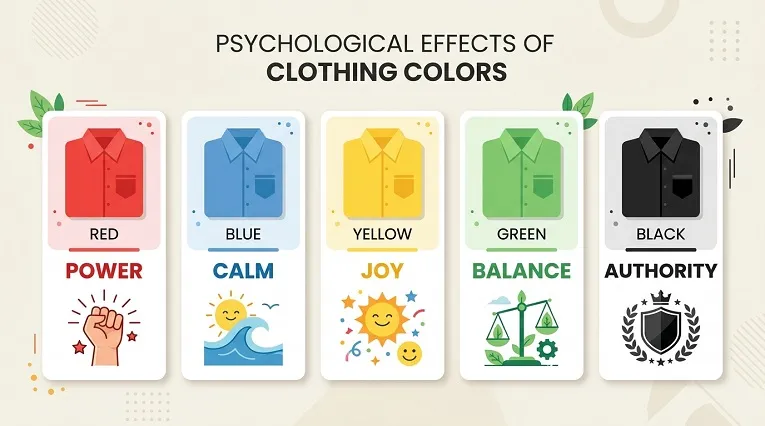
Color is one of the fastest, least conscious ways clothing affects your emotions. Humans have built associations with color through culture and environment over a long time, and those associations shape both how we feel and how others read us.
| Color | Common Psychological Association | Good For |
|---|---|---|
| Red | Confidence, energy, power | Interviews, presentations, power dressing |
| Blue | Calm, trust, focus | Workdays, meetings, steady decision-making |
| Yellow | Optimism, warmth | Social events, creative work, mood lifts |
| Green | Balance, reassurance | Days that need patience |
| Black | Authority, control | Formal settings, evening events |
| White or neutral | Clarity, simplicity | Minimalist days, high-focus work |
A 2014 study published in Color Research and Application found that people who wore red reported feeling more confident and were also rated by observers as more attractive. That is a useful detail for anyone picking an outfit for a high-pressure moment.
The point is not to color-code every single day of your life. The point is that color is a lever you can pull on purpose. Most people pick colors out of habit or whatever is clean. Choosing with intention, even occasionally, gives you a small but real tool for managing how you feel.
Dressing for the Role You Want to Play
The lab coat experiment offers a strategy you can actually use. Clothing shifts your mindset most strongly when it carries a clear meaning to you and you physically wear it, not when it just sits in your closet looking nice.
This is the real psychology behind the old advice to “dress for the job you want.” It is not about appearances for their own sake. It is about using clothing as a cue that nudges your mind toward focus, confidence, or creativity, depending on what the moment requires.
Here is how to apply it in real situations:
Before a task that needs deep focus (studying, exams, detailed work): choose structured clothing over loungewear. The physical formality can prime attentiveness, the same way the lab coat primed sustained attention in the original study.
Before a high-stakes social moment (interview, presentation, first date): wear a piece with a strong, personal, confident association. This is different for everyone, but common examples include a tailored jacket, a signature color, or an outfit tied to a memory of past success.
On a low-motivation day, resist the autopilot choice of comfort clothes only. A small upgrade, like real shoes instead of slippers or a clean shirt instead of yesterday’s, can work as a low-effort mood intervention.
Clothing, Identity, and a Sense of Belonging
Fashion psychology goes beyond individual mood into identity and connection. Wearing clothing tied to a subculture, profession, team, or community can reinforce a sense of belonging, which in turn supports confidence and emotional steadiness. This is part of why uniforms, team colors, and style communities such as streetwear, vintage, or minimalist fashion carry such strong emotional weight for the people who wear them. The clothing is doing identity work, not just visual work.
This also explains why dressing authentically, meaning in a way that actually matches your personality rather than a trend you feel pressured into, tends to produce a stronger and more lasting confidence boost than simply following what is popular. Authenticity closes the gap between how you look and how you actually feel inside, and that gap is exactly what creates self-consciousness when it is too wide.
What to Wear for Different Mental States: A Quick Reference
People often ask what they should actually wear for a specific feeling or goal. Here is a direct, practical answer based on the principles above.
| You want to feel… | Try wearing… | Why it works |
|---|---|---|
| More confident | A well-fitted piece in a bold color like red or a personal “power” item | Combines color psychology with symbolic meaning |
| More focused | Structured, clean clothing over loose loungewear | Mirrors the lab coat effect on attention |
| Calmer | Blue or green tones, soft and comfortable fabrics | Cooler colors are linked to relaxation and stability |
| More creative | Clothing that feels expressive or unconventional for you | Supports psychological freedom and individuality |
| Comfortable but still capable | Well-fitted basics over baggy “hiding” clothes | Keeps physical comfort without losing the confidence cue |
This table is meant as a starting point, not a strict rule. The strongest effects always come from clothing that holds real personal meaning for you, not just clothing that matches a chart.
Practical Steps to Build a Mood-Supportive Wardrobe
- Audit for emotional dead weight. Go through your closet and flag anything that makes you feel less than neutral when you picture wearing it. Old, ill-fitting, or “someday” items quietly chip away at confidence every time you see them.
- Identify your power pieces. Note the three to five items you consistently feel best in. Look for the common thread, whether it is color, fit, fabric, or a memory attached to them, and look for more pieces in that same direction.
- Match clothing to the day’s emotional demand, not just the weather. Before getting dressed, ask what the day actually requires: focus, warmth, confidence, or comfort. Choose with that question in mind.
- Use color on purpose during tough days. If you are dreading something, avoid defaulting to all black or all gray. A single confident color can act as a small but real psychological lift.
- Choose fit over quantity. Comfortable, well-fitted basics consistently support mood better than trend pieces that do not actually fit well, since physical comfort is one half of the enclothed cognition equation.
- Notice your “interrupt” outfit. Pick one outfit specifically for low-mood mornings, something that reliably makes you feel more like yourself. Having this decided in advance removes the friction of choosing while you already feel low.
Section summary: A mood-supportive wardrobe is not about owning more clothes. It is about removing pieces that quietly drain confidence and being intentional about what you reach for on different kinds of days.
Common Questions About Fashion and Psychology
Does what you wear really affect your mood, or is it just a placebo? It is more than a placebo. Enclothed cognition research shows measurable differences in attention and behavior, not just self-reported feelings, tied to what people wear and what that clothing symbolizes to them.
What is enclothed cognition in simple terms? It is the psychological effect where the clothes you physically wear, combined with what those clothes mean to you, shape your thoughts, focus, and behavior, not just how you look.
Can changing your outfit actually improve a bad mood? Yes, to a meaningful degree. Choosing an outfit linked to comfort, confidence, or a positive memory can act as a real, if modest, mood shift, especially when paired with a color associated with energy or calm.
Why do certain colors make people feel more confident? Color associations build up over a lifetime through culture and environment. Red is commonly linked to energy and power, which is part of why power dressing often leans on bold, saturated colors for high-stakes moments.
Is dressing well actually linked to self-esteem? Yes. Research connects intentional, well-fitted, authentic clothing choices to higher self-reported confidence and lower social anxiety, largely because clothing reinforces identity and narrows the gap between how someone looks and how they want to feel.
What is the halo effect in fashion? It is the tendency for people to assume someone is more competent, trustworthy, or capable simply because they are well-dressed. It is a bias, not a fair judgment, but it is a real factor in how first impressions form.
Does this mean expensive clothes are necessary for confidence? No. The research points to fit, personal meaning, and intention, not price. A well-fitted, simple piece that feels authentic to you will outperform an expensive item that does not feel like “you.”
Conclusion
Clothing is not just decoration. It is a daily psychological tool, whether you use it on purpose or not. The science of enclothed cognition shows that what you wear can shift your focus, your confidence, and your mood, especially when a piece of clothing carries real personal meaning and you are actually wearing it. Color adds another layer, nudging your emotional state in small but measurable ways. And the halo effect means your clothing choices ripple outward, shaping how other people respond to you too.
None of this requires a complicated wardrobe or a big budget. It requires attention. Notice what you already feel best in. Remove what quietly drains you. Choose with the day’s actual needs in mind instead of habit alone. That shift in approach, more than any specific item, is what turns getting dressed from a routine task into a genuine tool for how you feel.
Fashion psychology research continues to grow, and individual responses to clothing vary from person to person. If you are going through a difficult emotional period, dressing with intention can help, but it is not a substitute for professional support if you are struggling with your mental health.