
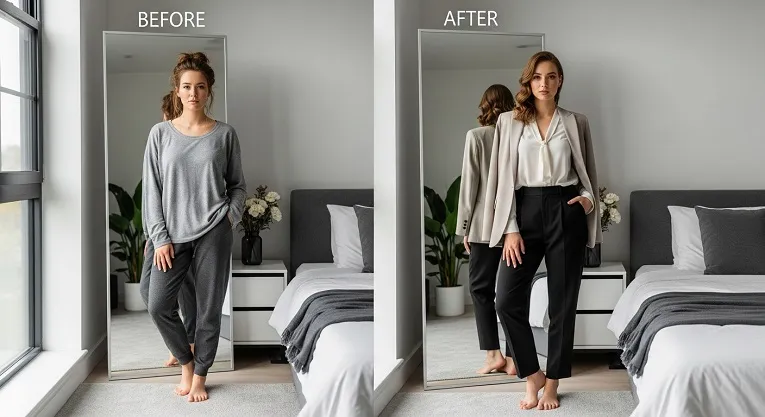
Quick answer: A wardrobe is quietly undermining your confidence if you regularly avoid certain items, feel the need to adjust or tug at clothing throughout the day, or default to the same “hiding” outfit whenever you feel low. A short audit can identify which pieces are helping and which are working against you.
Most people do not think of their wardrobe as something that affects confidence day to day, but a few quiet patterns usually reveal it clearly once you look for them. Here is a simple way to check.
Signs Your Wardrobe Needs an Audit
| Sign | What It Usually Means |
|---|---|
| You adjust or tug at an item repeatedly during the day | The fit is off, which keeps pulling attention back to your clothing |
| You reach for the same “hiding” outfit on low days | It may be reinforcing low energy rather than lifting it |
| Certain items sit unworn despite owning them | They likely do not match how you actually want to feel or look |
| You feel more self-conscious in specific pieces | The gap between how you look and how you want to feel is too wide |
| Getting dressed regularly feels stressful or slow | Too many mismatched or ill-fitting options create decision fatigue |
A Simple Wardrobe Audit
- Try on anything you have not worn in the last two months and note how it actually feels, not just how it looks on the hanger.
- Set aside anything that needs constant adjusting, regardless of how much it cost or how much you like the style.
- Identify three to five pieces you consistently feel best in, and look for what they have in common.
- Choose one outfit specifically for low-confidence days, decided in advance rather than chosen while already feeling low.
The Step-by-Step Wardrobe Confidence Audit
The short list above gives you the idea. This fuller process turns it into a proper audit you can finish in about an hour. Work through the steps in order.
Step 1: Set Aside Time and Space
Pick a time when you will not be rushed. An hour on a quiet weekend morning usually works better than a tired evening after work. Clear a space in front of a full length mirror.
Wear simple underwear and keep your usual shoes close by. Judge each piece the way you would actually wear it, not the way it looks on a hanger.
Step 2: Try On by Category, Not by Hanger
Work through one category at a time. Start with tops, then move to trousers and skirts, then dresses, then jackets and coats. Trying on by category keeps the task manageable.
Put each piece on properly. Button it, zip it and sit down in it. A top that looks fine while you stand still can pull or ride up the moment you sit down.
Step 3: Score Each Piece on Fit, Comfort and Feeling
Give every piece three quick scores. First, fit: does it sit smoothly without pulling or gaping? Second, comfort: can you move, sit and breathe easily? Third, feeling: do you stand taller in it, or do you want to hide?
| Test | Ask yourself |
|---|---|
| Fit | Does it sit smoothly, without pulling or gaping? |
| Comfort | Can I move, sit and breathe easily in it? |
| Feeling | Do I stand taller in it, or do I want to hide? |
A piece needs to pass all three tests to earn a regular place in your wardrobe.
Step 4: Sort Into Keep, Fix and Remove Piles
Make three piles as you go. Keep covers pieces that pass all three tests and that you actually reach for. Fix covers pieces you love but that need a small repair or a hem. Remove covers pieces that fail on fit, comfort or feeling.
Be honest with the remove pile. A high price tag or a gift label does not make an uncomfortable piece worth keeping. Bag it up straight away.
Step 5: Find Your Confidence Pattern
Look at your keep pile as a group. What do the pieces have in common? You may notice a neckline you return to, a fabric that feels good, or a colour that lifts your mood.
Write the pattern down in one or two sentences. For example, you might note that you feel best in structured shoulders, soft cotton and navy. That sentence becomes your filter the next time you shop.
Step 6: Build Your Low-Confidence Outfit and Your Everyday Rotation
Choose one complete outfit from your keep pile for low confidence days, and hang it together so you can reach for it without thinking. Decide it now, while you feel calm, rather than on a morning when you already feel low.
Then build a small everyday rotation from the rest of the keep pile. Five or six outfits that you know work will cover most weeks, and they remove the daily decision that drained your confidence.
Quick Checklist Before You Leave the House
- Does it fit properly, without needing regular adjustment?
- Is it comfortable enough that you will forget you are wearing it?
- Does it suit what the day actually requires?
- Do you feel like yourself in it?
Printable Wardrobe Confidence Audit Checklist
Tick each item off as you finish it. You can print this page or copy the list into your notes.
- Set aside one uninterrupted hour and clear space in front of a mirror.
- Try on every piece you have not worn in the last two months.
- Button, zip and sit down in each piece before you judge it.
- Score each piece for fit, comfort and feeling.
- Sort everything into keep, fix and remove piles.
- Bag up the remove pile straight away.
- Write down the pattern your keep pile shares.
- Hang one complete low confidence outfit together.
- Build a rotation of five or six outfits you trust.
- Repeat the audit every few months.
Expert Insight
Stylists often note that people underestimate how much a single ill-fitting item can drag down an otherwise good outfit. Removing or replacing just one or two persistently uncomfortable pieces from regular rotation tends to have a bigger impact than adding several new items.
Frequently Asked Questions
How often should a wardrobe audit be done? Every few months is usually enough to catch pieces that no longer fit well or suit your current routine.
Is it normal to feel different in different outfits? Yes, this is a well-documented effect, and using it intentionally, rather than by accident, is the basis of dressing for how you want to feel.
What should I do with clothes that no longer fit but I still love?
Keep one or two pieces if they carry real meaning, and store them out of your everyday wardrobe. Let the rest go. A wardrobe full of clothes that do not fit today quietly reminds you of the gap every morning.
Can I audit my wardrobe without buying anything new?
Yes. The audit works best when you buy nothing at all for the first few weeks. Most people find they already own enough pieces that pass the test. New purchases should only fill a clear gap you found during the audit.
What if almost everything in my wardrobe fails the audit?
Start with the pieces that pass, even if there are only three or four of them. Build outfits from those, and add one well chosen replacement at a time. A small wardrobe that fits serves your confidence far better than a full rail of pieces you avoid.
For the science behind why this happens, see our guide to the psychology of dressing well, and for specific pieces to reach for, see 9 clothes that boost confidence instantly.
About the Author: This guide was written by Ellen Stevens, Founder & Editor at Fashion Effects, who researches the everyday link between clothing and confidence to help readers dress with more ease.